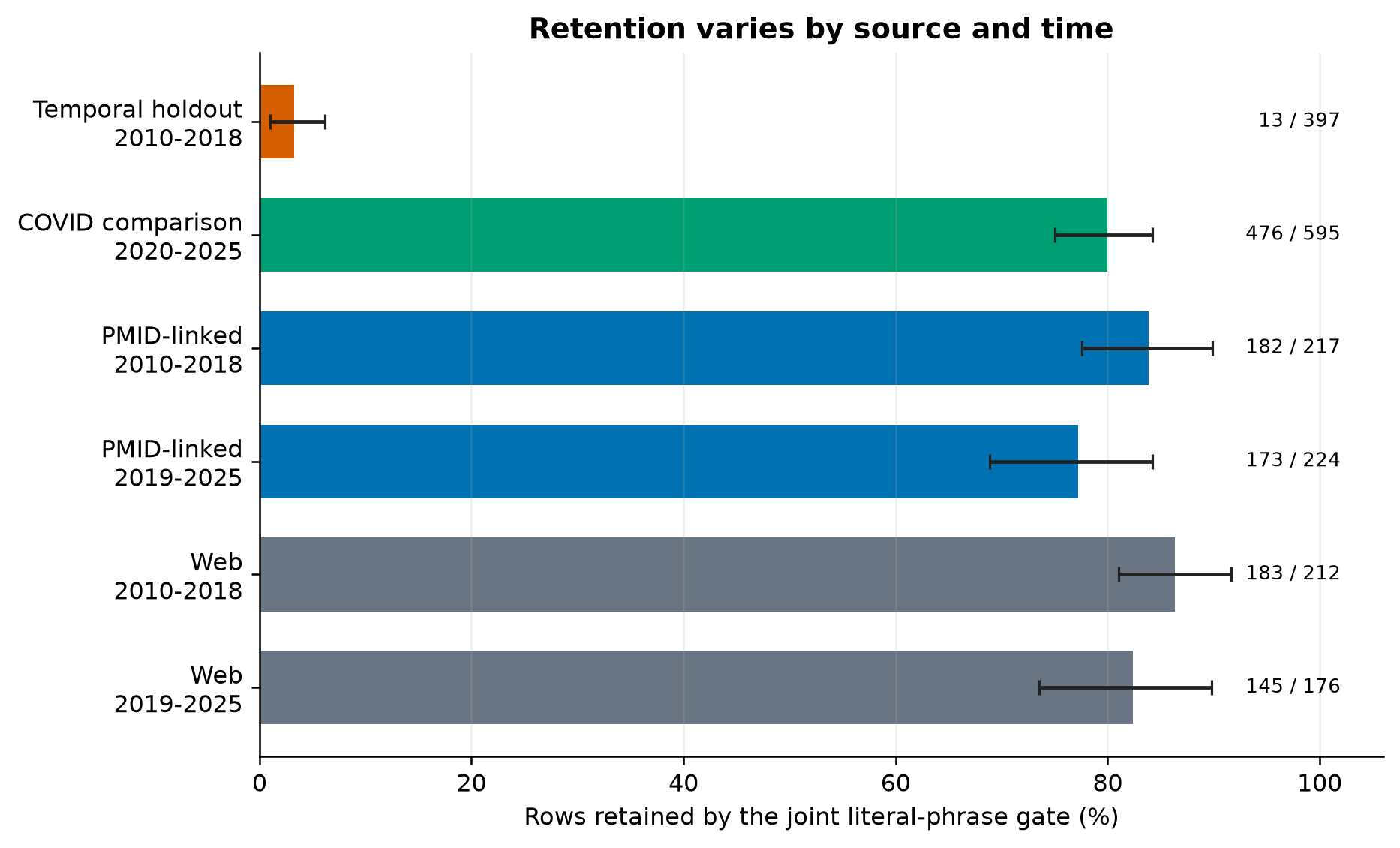
We recovered archived extractor inputs for 1,012 of 1,030 sampled documents. In the new temporal holdout, 299 recovered inputs contain none of the tested COVID-family terms, yet their released outputs include 380 explicit COVID-family rows. A fixed lexical rejection rule withholds all 380.
A retained-checkpoint replay matches the full released tuples for 62 of 70 new documents. The same model generates 51 COVID-family rows from 30 temporal inputs; all fail the proposed safeguard. In the general sample strata, the safeguard retains 77.2–86.3% of rows. These are measured computational outcomes, not clinical accuracy estimates.
These are stratified experimental samples, not population-proportional samples or a replacement HCC release. Literal entity support does not establish a true or even textually entailed relationship. Independent human semantic validation remains outstanding.
The audited HCC v1.0 data are archived on Zenodo and Figshare. Original release files are unchanged. Code, sampled decisions, input fingerprints, replay outputs and aggregate results are available here. Full historical input passages and model weights are not redistributed, limiting independent regeneration of the added replay experiments.